

How to Convert SaaS Leads into Paying Customers Even If Your Product is New


For SaaS (Software as a Service) companies, the biggest challenge is converting leads into paying customers. The SaaS Demo Funnel is an effective strategy that nurtures prospects by guiding them through a structured journey—starting from awareness, building interest with a demo, and leading them toward making a purchase.
In this blog, I’ll break down the key components of the SaaS Demo Funnel and how you can optimize it for higher conversions.
What is a SaaS Demo Funnel?
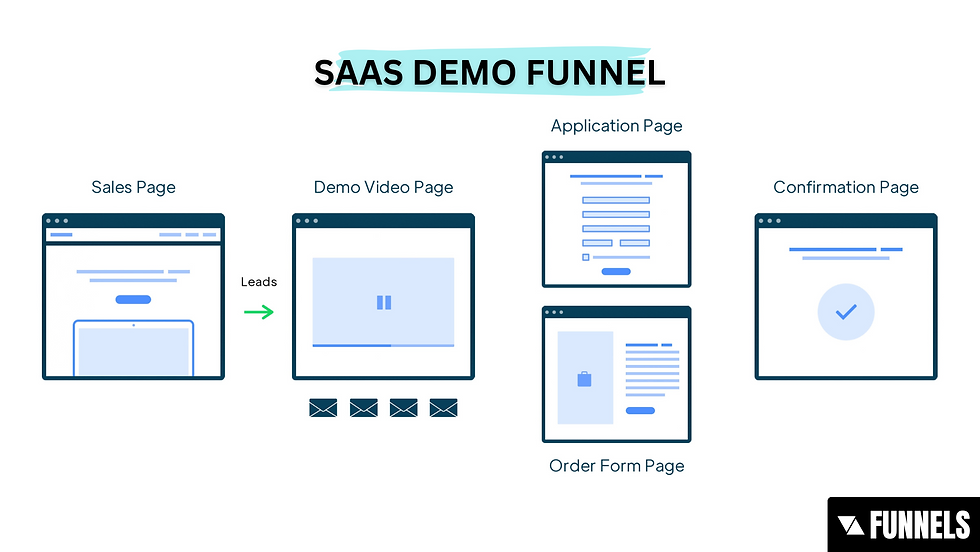
A SaaS Demo Funnel is a strategic sequence of web pages designed to educate potential customers, demonstrate the value of your software, and convert them into paying users. Unlike traditional marketing funnels, a SaaS funnel is focused on providing an interactive and engaging experience that showcases your product’s functionality and benefits.
Key Components of a SaaS Demo Funnel
A typical SaaS Demo Funnel consists of the following pages:
Sales Page
Demo Video Page
Application Page
Order Form Page
Confirmation Page
Let’s go through each stage in detail.
1. Sales Page
The Sales Page is the first touchpoint where potential customers land after clicking on an ad, email link, or organic search result. This page must be compelling enough to grab attention and encourage users to explore further.
Essential Elements:
A clear and persuasive headline that addresses the pain points of your audience.
A subheadline that highlights how your SaaS product solves the problem.
A hero image or video showcasing the product interface.
Call-to-action (CTA): A prominent button leading to the next step, such as “Watch Demo” or “Try for Free.”
Social proof: Testimonials, case studies, or trust badges to build credibility.
Goal: Capture the interest of visitors and get them to move to the next step—watching the demo.
2. Demo Video Page
Once visitors click the CTA on the Sales Page, they are redirected to the Demo Video Page. This page plays a crucial role in educating and convincing prospects about the value of your SaaS product.
Essential Elements:
A high-quality video demo explaining how the software works and its key benefits.
Bullet points or short text highlights summarizing what the demo covers.
Engagement CTA: Options like “Sign Up for Free Trial” or “Book a Live Demo” to encourage the next step.
Email Capture Forms: Collecting emails for follow-up sequences.
Goal: Get users to take action by either signing up for a trial, booking a demo call, or proceeding to the next step.
3. Application Page
For high-ticket SaaS products, it’s important to qualify leads before they proceed. The Application Page collects relevant information from potential customers to ensure they are a good fit.
Essential Elements:
A short questionnaire asking about business needs, budget, and goals.
Input fields for name, email, and company details.
A CTA button like “Submit Application” or “Proceed to Checkout.”
Goal: Qualify leads and move them to the next step, filtering out unqualified prospects.
4. Order Form Page
If a prospect is interested and qualifies, they move to the Order Form Page to complete the purchase or subscription process.
Essential Elements:
Pricing details and plan options.
Secure checkout process to enter payment details.
Money-back guarantee or a risk-free trial offer to reduce hesitation.
One-click upsells or add-ons (if applicable) to increase average order value.
Goal: Convert the prospect into a paying customer.
5. Confirmation Page
Once a user completes the purchase, they land on the Confirmation Page, which serves as the final step in the funnel.
Essential Elements:
Thank You Message confirming the purchase or demo booking.
Next Steps Information, such as login details or what to expect in a demo call.
Additional Offers, like referrals or exclusive discounts for upsells.
Goal: Provide a seamless post-purchase experience and encourage further engagement.
Optimizing Your SaaS Demo Funnel for Maximum Conversions
To improve the performance of your funnel, consider these best practices:
A/B Test Your Sales Page – Experiment with headlines, CTAs, and page layouts to see what converts best.
Keep the Demo Short & Engaging – Highlight the most impactful features within 5–10 minutes.
Follow-Up with Email Sequences – Use automated email follow-ups to nurture leads who watched the demo but didn’t take action.
Include Social Proof – Case studies, testimonials, and customer success stories build trust.
Reduce Friction in the Order Process – Ensure a smooth checkout experience with minimal form fields.
Offer a Risk-Free Trial – If possible, provide a free trial or money-back guarantee to eliminate purchase barriers.
Conclusion
A well-optimized SaaS Demo Funnel is the key to converting prospects into loyal customers. By strategically guiding users through a structured journey—starting from the sales page, moving to a demo, filtering qualified leads, and closing the sale—you can maximize conversions and drive business growth.
Implement these funnel strategies, and you’ll see an increase in trial sign-ups, demo bookings, and ultimately, revenue! 🚀
Cheers ☕


Comments